Divine Hiddenness: New Essays by Daniel Howard-Snyder & Paul Moser
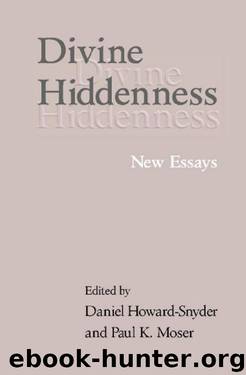
Author:Daniel Howard-Snyder & Paul Moser [Howard-Snyder, Daniel & Moser, Paul]
Format: epub
Tags: REVELATION
Published: 2010-05-03T06:38:12.131000+00:00
(Romans 5:5; cf. 2 Corinthians 5:16–17; 1 John 4:12–13,16,19. On the role of the Spirit in Paul’s epistemology, see 1 Corinthians 2:4–16.) The presence of God’s morally transforming love is the central epistemic, or evidential, foundation for filial knowledge of God. Such love is a foundational source of knowledge of God (cf. Colossians 2:2; 1 Corinthians 8:2–3.) It is real evidence of God’s reality and presence. This love is a matter of personal intervention by God and the basis of a personal relationship with God. It is the distinctive presence of a personal God. So the filial knowledge in 144
paul k. moser
question rests on morally transforming divine love that produces a loving character in genuine children of God, even if at times such people obstruct God’s transformation. This transformation happens to one, in part, and thus is neither purely self-made nor simply the byproduct of a self-help strategy. (I say “in part” owing to the role of human freedom in seeking and responding to God.) This widely neglected supernatural sign is available (at God’s appointed time) to anyone who turns to God with moral seriousness. It transforms one’s will (a) to have gratitude, trust, and love toward God and (b) to love others unselfishly. Accordingly, we know that we have passed from death to life because we love one another . . . Whoever does not love does not know God, for God is love” (1 John 3:14, 4:8, NRSV). We need to learn, then, how to apprehend, and to be apprehended by, God’s love for all people. Such divine love is neither a proposition nor an argument.
God’s self-revelation of transforming love will take us beyond mere historical and scientific probabilities to a firm foundation of personal acquain- tance with God. As Paul remarks, in our sincerely crying out “Abba, Father”
to God (note the Jesus-inspired filial content of this cry), God’s Spirit confirms to our spirit that we are indeed children of God (Romans 8:16). We thereby receive God’s personal assurance of our filial relationship with God. This assurance is more robust than any kind of theoretical certainty offered by philosophers or theologians. It liberates a person from dependence merely on the quagmire of speculation, hypothesis-formation, probabilistic inference, or guesswork about God. Such assurance yields a distinctive kind of grounded firm confidence in God unavailable elsewhere. God thus merits credit even for proper human confidence in God (cf. Ephesians 2:8).
The evidence of God’s presence offered by character transformation in God’s genuine (not just nominal) children deserves serious consideration. It goes much deeper than the comparatively superficial evidence found in entertaining signs, wonders, visions, ecstatic experiences, and philosophical arguments. We could consistently dismiss any such sign, wonder, vision, ecstatic experience, or argument as illusory or indecisive, given certain alterations in our beliefs. In contrast, genuine character transformation toward the JewishChristian God’s ideal of all-inclusive love does not admit of easy dismissal. It bears directly on who one really is, the kind of person one actually is. Such transformation cuts too deeply against our natural tendencies toward selfishness to qualify as a self-help gimmick.
Download
This site does not store any files on its server. We only index and link to content provided by other sites. Please contact the content providers to delete copyright contents if any and email us, we'll remove relevant links or contents immediately.
| Anthropology | Archaeology |
| Philosophy | Politics & Government |
| Social Sciences | Sociology |
| Women's Studies |
The remains of the day by Kazuo Ishiguro(8999)
Tools of Titans by Timothy Ferriss(8396)
Giovanni's Room by James Baldwin(7346)
The Black Swan by Nassim Nicholas Taleb(7129)
Inner Engineering: A Yogi's Guide to Joy by Sadhguru(6796)
The Way of Zen by Alan W. Watts(6614)
The Power of Now: A Guide to Spiritual Enlightenment by Eckhart Tolle(5781)
Asking the Right Questions: A Guide to Critical Thinking by M. Neil Browne & Stuart M. Keeley(5775)
The Six Wives Of Henry VIII (WOMEN IN HISTORY) by Fraser Antonia(5515)
Astrophysics for People in a Hurry by Neil DeGrasse Tyson(5190)
Housekeeping by Marilynne Robinson(4447)
12 Rules for Life by Jordan B. Peterson(4304)
Ikigai by Héctor García & Francesc Miralles(4274)
Double Down (Diary of a Wimpy Kid Book 11) by Jeff Kinney(4272)
The Ethical Slut by Janet W. Hardy(4253)
Skin in the Game by Nassim Nicholas Taleb(4248)
The Art of Happiness by The Dalai Lama(4130)
Skin in the Game: Hidden Asymmetries in Daily Life by Nassim Nicholas Taleb(4007)
Walking by Henry David Thoreau(3962)
